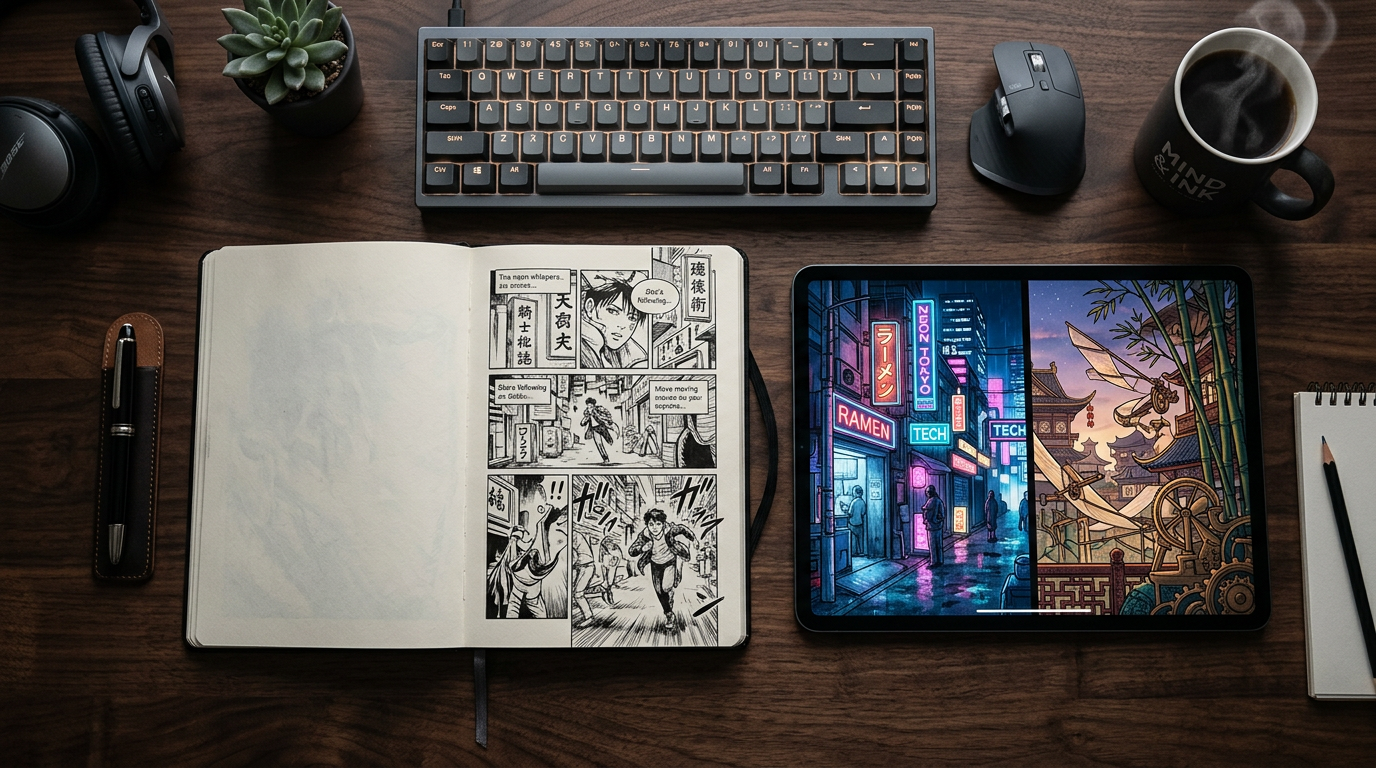
I knew cyberpunk and steampunk. I could recognize the broad shape of atompunk when a story filled its future with midcentury optimism, nuclear anxiety, polished chrome, and technology imagined through Atomic Age dreams. Three labels felt manageable. Then I learned about silkpunk, mythpunk, solarpunk, hopepunk, ribofunk, mannerpunk, clockpunk, and a growing crowd of other names. My immediate reaction was simple: You have got to be kidding. How long does this list get?
That question opened a much larger conversation for me because I approach stories from two connected directions. I read Western novels, manga, light novels, and fiction from writers across different cultures. Every new literary term gives me another way to notice what an author has placed beneath the plot. A label can point toward the materials that power a world, the historical period that shapes it, the institutions that control it, the values its characters defend, or the traditions that influence how the author tells the story.
Plenty of readers and viewers may never want to debate whether a term describes a genre, subgenre, movement, mode, framework, or aesthetic. They can still gain something useful from knowing that the terms exist. Once a person recognizes the fingerprints, a city powered by steam, a society organized around biotechnology, or a future rebuilt through ecological cooperation starts to reveal more of its design. That recognition can happen in a novel, manga, anime, movie, television series, or game. The medium changes, while the underlying questions about power, technology, history, and resistance continue.
This article follows the rabbit hole as I understand it so far and treats the subject as an open investigation. No single authority controls this vocabulary, and writers, critics, publishers, gamers, and fandom communities have all contributed to it. Some labels carry decades of literary history. Individual writers coined others to describe a particular approach, and readers apply still others retroactively to stories whose creators never used the term. Those differences matter because a useful label should clarify a story without forcing it into a box.
When Three Familiar Punks Became a Much Larger Question
My curiosity began with the familiar side of the family tree. Cyberpunk taught generations of readers and viewers to associate advanced technology with corporate power, surveillance, body modification, social alienation, and people surviving along the edges of a system. Steampunk made a different visual promise through steam power, brass machinery, factories, airships, and nineteenth-century industrial culture. Atompunk looked toward the Atomic Age through nuclear anxiety, space-race optimism, midcentury design, and futures imagined through that period’s faith in technology.
Those three names gave me the impression that I understood the basic pattern. Each one appeared to connect a recognizable technology or historical period to a particular kind of fictional world. Then I encountered terms that operated differently. Some pointed toward cultural traditions. Others described the way a writer reworked mythology, how a community resisted pressure, or what kind of power governed everyday life. The suffix had traveled much farther than I realized.
That discovery changed the question I wanted to ask. Counting every term could show me the size of the vocabulary, but recognition offered a more satisfying purpose. I wanted to understand what these names could reveal while I read manga and light novels, watched anime and movies, or entered a new fictional world through a game. The name mattered because it gave me another way to see how the story worked.
Why Silkpunk and Mythpunk Changed the Way I Look at Stories

Silkpunk caught my attention because Ken Liu built the term around more than scenery. He coined it for the Dandelion Dynasty series to describe both a technological aesthetic and a literary approach. The world’s engineering draws from materials with historical importance across East Asia and the Pacific Islands, including bamboo, silk, paper, shells, coral, feathers, and sinew. Machines imitate biological forms, while the storytelling draws from East Asian historical romance, classical texts, poetry, and Western epic traditions.
That explanation showed me how deeply a framework could enter a story. Silk clothing or bamboo machinery could provide visible clues, yet Liu connects those details to engineering logic, cultural history, political resistance, and narrative form. The society invents through the materials it knows. Its people inherit specific traditions, argue with authority, and tell stories through forms shaped by their history. The framework reaches the page through the world and through the way the author narrates it.
Mythpunk directed my attention somewhere else. Catherynne M. Valente coined the term while thinking about writers who broke inherited myths, folklore, and fairy tales apart and reconstructed them through contemporary techniques and perspectives. A mythpunk story may ask who controlled the older version, whose voice disappeared from it, and what changes when another storyteller takes hold of the narrative.
The presence of a familiar god, legend, or fairy-tale figure does not automatically make a story mythpunk. The framework becomes visible through the story’s relationship with the source material. Does the writer repeat the inherited version, or challenge the authority behind it? Does the retelling restore a perspective that the older story pushed aside? Those questions help me recognize the difference between borrowing mythology and actively arguing with it.
Silkpunk and mythpunk showed me why these labels cannot all function as interchangeable genre boxes. One term can join materials, technology, cultural history, and literary form. Another can describe an approach to inherited stories. Both help readers look below the plot, but they direct attention toward different parts of the construction.
Recognizing the Framework Across the Page and Screen

Recognition begins with practical questions. What powers this world? Which materials or technologies can people access? Who controls those resources? Which historical period or cultural tradition shapes daily life? What pressure does the system place on ordinary people, and how do characters resist, adapt, cooperate, or survive? These questions work across media because worldbuilding never belongs exclusively to prose. Animation, costume design, architecture, sound, machinery, landscape, and character movement can reveal the same framework before a narrator explains it.
A casual viewer can begin with visible clues and then watch how the story uses them. Steam engines and nineteenth-century factories may suggest steampunk, but the world becomes clearer when those inventions shape labor, class, empire, or access to power. A retelling may use a familiar myth, but its deeper relationship with mythpunk appears when the story challenges the values or authority of the inherited version. The clue opens the door. The system shows how far the framework reaches.
Manga and anime make this kind of recognition especially interesting because English-language genre labels may reach the work after its creation. A Japanese creator may draw from Japanese history, folklore, religion, architecture, or technology without ever using an English-language punk term. A reader can still apply the vocabulary as an interpretive lens when they clearly identify it that way. This phrasing keeps the work’s cultural context and the reader’s classification in their proper places.
Naruto offers a useful example. Masashi Kishimoto built a world that combines modern conveniences with political and military structures drawn from premodern Japan. Televisions, cameras, genetic knowledge, and communication technology exist alongside daimyos, clans, ninja villages, and inherited techniques. Certain parts of Naruto’s worldbuilding appear to contain feudalpunk elements. However, labeling feudalpunk as the series’ official genre would reach beyond the available evidence..
The Marshal King pushed that recognition in another direction for me. Its arid world and survival conditions made me think about desertpunk, while its machinery and Wild West design invited comparisons to steampunk. Dune can also invite a desertpunk interpretation because ecology, water scarcity, survival, and political power grow from its desert setting. These comparisons help when I name the elements that support them and treat the label as one layer of the work.
Stories overlap constantly, so recognition does not require a perfect one-label answer. A novel, manga, anime, or movie may combine several frameworks or use one only in part of its worldbuilding. The most useful observation explains what I see: this story uses a feudal political structure alongside modern technology, this retelling challenges the authority of its source mythology, or this setting allows desert ecology to shape power and survival. The label gives that observation a name and a path toward further discovery.
Casual viewers and readers who enjoy deeper analysis can begin at the same point. One person may feel satisfied after naming the atmosphere of a favorite movie. Another may trace how the framework shapes politics, labor, gender, culture, or the environment. In both cases, the vocabulary sharpens attention and gives the audience a clearer way to discuss what the story has built.
Talk Out Daily Final Thoughts
I entered this rabbit hole because I wanted names for things I could sense while reading and watching stories. I recognized that certain worlds shared materials, social systems, visual languages, or forms of resistance, but I did not always have the vocabulary to describe those relationships. Learning the names gave me a new set of questions. Now I can look beyond the costume or machine and ask what the framework changes about power, history, culture, conflict, and the choices available to the characters.
That recognition feels like the real reward. Someone watching an anime may suddenly notice how a feudal political structure operates alongside modern technology. A manga reader may recognize a story dismantling inherited mythology instead of simply borrowing familiar names. A moviegoer may see that an ecological future depends on shared systems and political choices, rather than a skyline covered in plants. The label becomes useful when it helps us see what the story is doing.
My interest also follows me into my own independent writing. I am still learning how these frameworks work, and I do not present myself as a creative-writing authority. Learning the vocabulary has already expanded the possibilities I can consider when I build a world. I can ask which materials shape invention, who controls knowledge, what history produced the present system, and how resistance changes everyday life. Those questions give me more deliberate choices as I continue developing my own stories.
I began with a simple reaction to an unexpectedly long list. I came away with a new way to read and watch. The moment of recognition can happen anywhere. A costume, a machine, a political system, a retold myth, or a character’s form of resistance can reveal the framework before a story gives it a name. That moment makes the rabbit hole worth following.
Sources
1. Cyberpunk. The Encyclopedia of Science Fiction. Read source
2. Steampunk. The Encyclopedia of Science Fiction. Read source
3. What Is Silkpunk?. Ken Liu. Read source
4. Mythpunk: An Interview with Catherynne M. Valente. Strange Horizons. Read source
5. The Medievalism of Naruto. Medievalists.net. Read source
6. The Marshal King. MANGA Plus by Shueisha. Read source




Leave a Reply